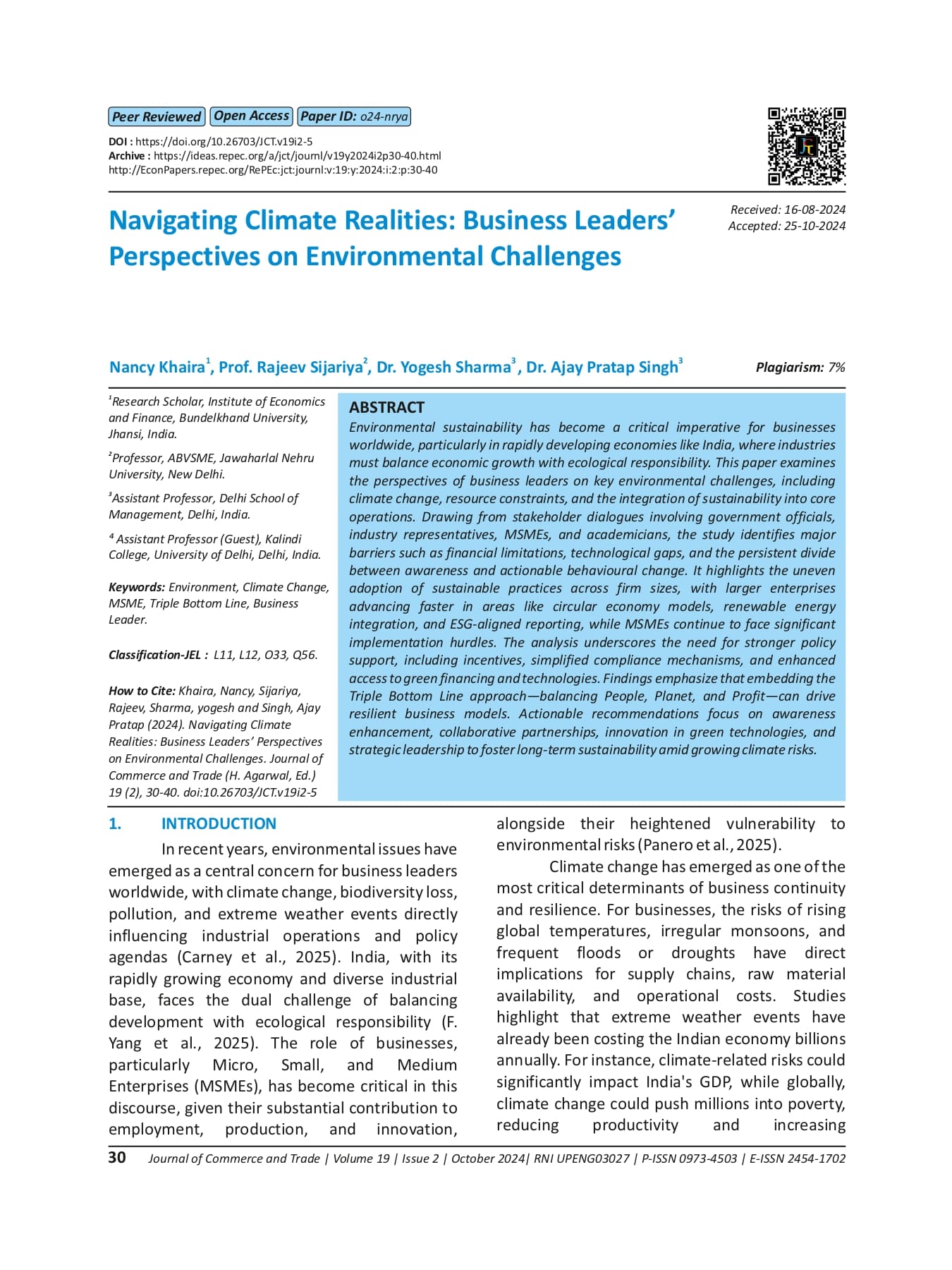
Navigating Climate Realities: Business Leaders’ Perspectives on Environmental Challenges
DOI:
https://doi.org/10.26703/Keywords:
Environment, Climate Change, MSME, Triple Bottom Line, Business LeaderAbstract
Environmental sustainability has become a critical imperative for businesses worldwide, particularly in rapidly developing economies like India, where industries must balance economic growth with ecological responsibility. This paper examines the perspectives of business leaders on key environmental challenges, including climate change, resource constraints, and the integration of sustainability into core operations. Drawing from stakeholder dialogues involving government officials, industry representatives, MSMEs, and academicians, the study identifies major barriers such as financial limitations, technological gaps, and the persistent divide between awareness and actionable behavioural change. It highlights the uneven adoption of sustainable practices across firm sizes, with larger enterprises advancing faster in areas like circular economy models, renewable energy integration, and ESG-aligned reporting, while MSMEs continue to face significant implementation hurdles. The analysis underscores the need for stronger policy support, including incentives, simplified compliance mechanisms, and enhanced access to green financing and technologies. Findings emphasize that embedding the Triple Bottom Line approach—balancing People, Planet, and Profit—can drive resilient business models. Actionable recommendations focus on awareness enhancement, collaborative partnerships, innovation in green technologies, and strategic leadership to foster long-term sustainability amid growing climate risks.
Downloads
References
1. Agazu, B. G., Kero, C. A., & Debela, K. L. (2025). Transformational leadership and firm performance: a systematic literature review. Journal of Innovation and Entrepreneurship, 14(1). https://doi.org/10.1186/s13731-025-00476-x
2. Ajay, S. R., & Kumar, R. (2023). Assessment of Environmental Sustainability of Manufacturing Practices of Indian SMEs in COVID Era. Lecture Notes in Mechanical Engineering, 69–77. https://doi.org/10.1007/978-981-99-1328-2_7
3. AlQudah, M. Z., Sierra-Garcia, L., & García-Benau, M. A. (2025). ESG and emerging technologies: A cluster-based literature review analysis. Sustainable Futures, 10. https://doi.org/10.1016/j.sftr.2025.101285
4. Anadon, L. D., Chan, G., Harley, A. G., Matus, K., Moon, S., Murthy, S. L., & Clark, W. C. (2016). Making technological innovation work for sustainable development. Proceedings of the National Academy of Sciences of the United States of America, 113(35), 9682–9690. https://doi.org/10.1073/PNAS.1525004113
5. Arena, M., & Azzone, G. (2012). A process-based operational framework for sustainability reporting in SMEs. Journal of Small Business and Enterprise Development, 19(4), 669–686. https://doi.org/10.1108/14626001211277460
6. Azzone, G., & Noci, G. (1998). Identifying effective PMSs for the deployment of “green” manufacturing strategies. International Journal of Operations and Production Management, 18(4), 308–335. https://doi.org/10.1108/01443579810199711
7. Berelson, B. (1952). Democratic theory and public opinion. Public Opinion Quarterly, 16(3), 313–330. https://doi.org/10.1086/266397
8. Bhupendra, K. V., & Sangle, S. (2016). Pollution prevention strategy: a study of Indian firms. Journal of Cleaner Production, 133, 795–802. https://doi.org/10.1016/J.JCLEPRO.2016.05.169
9. Borga, F., Citterio, A., Noci, G., & Pizzurno, E. (2009). Sustainability report in small enterprises: Case studies in Italian furniture companies. Business Strategy and the Environment, 18(3), 162–176. https://doi.org/10.1002/BSE.561
10. Boskabadi, A., Mirmozaffari, M., Yazdani, R., & Farahani, A. (2022). Design of a Distribution Network in a Multi-product, Multi-period Green Supply Chain System Under Demand Uncertainty. Sustainable Operations and Computers, 3, 226–237. https://doi.org/10.1016/j.susoc.2022.01.005
11. Brammer, S., Hoejmose, S., & Marchant, K. (2012). Environmental Management in SMEs in the UK: Practices, Pressures and Perceived Benefits. Business Strategy and the Environment, 21(7), 423–434. https://doi.org/10.1002/BSE.717
12. BRSR Reporting fundamentals every Indian company must know. (n.d.). Retrieved September 24, 2025, from https://www.thesustainabilitycloud.com/blog/brsr-reporting-must-know/
13. Callan, S. J., & Thomas, J. M. (2011). Executive compensation, corporate social responsibility, and corporate financial performance: A multi-equation framework. Corporate Social Responsibility and Environmental Management, 18(6), 332–351. https://doi.org/10.1002/CSR.249
14. Campbell, D. J. (2000). Legitimacy Theory or Managerial Reality Construction? Corporate Social Disclosure in Marks and Spencer Plc Corporate Reports, 1969-1997. Accounting Forum, 24(1), 80–100. https://doi.org/10.1111/1467-6303.00030
15. Carney, C. P., Schultz, C. A., & Greiner, S. M. (2025). Complexities in post-wildfire governance: lessons from Colorado's 2020 wildfires. Fire Ecology, 21(1). https://doi.org/10.1186/s42408-024-00344-1
16. Chakraborty, A., Singh, M. P., & Roy, M. (2021). Educators' value orientations endorsing their willingness to participate in sustainable activities: A study from Indian higher education institutions. Studies in Higher Education, 46(6), 1025–1040. https://doi.org/10.1080/03075079.2019.1666260
17. Civera, C., Casalegno, C. G., Morelli, B., & Santoro, G. (2026). Seeds of change: Unpacking the enduring effects of MNC knowledge transfer in autonomous social innovation projects by fringe stakeholders. Technovation, 149. https://doi.org/10.1016/j.technovation.2025.103370
18. Climate Change Could Depress Living Standards in India, says New World Bank Report. (n.d.). Retrieved September 24, 2025, from https://www.worldbank.org/en/news/press-release/2018/06/28/climate-change-depress-living-standards-india-says-new-world-bank-report
19. Climate change could shave off 2.8% of India's GDP by 2050: World Bank | PreventionWeb. (n.d.). Retrieved September 23, 2025, from https://www.preventionweb.net/news/climate-change-could-shave-28-indias-gdp-2050-world-bank
20. Climate Tops 2022 WEF Global Risks Report | UNFCCC. (n.d.). Retrieved September 23, 2025, from https://unfccc.int/news/climate-tops-2022-wef-global-risks-report
21. Collaboration thus fosters People (job creation and education), Planet (collective conservation), and Profit (sustainable industrial ecosystems). - Google Search. (n.d.). Retrieved September 24, 2025.
22. Credit Linked Capital Subsidy Scheme. (n.d.). Retrieved September 24, 2025, from https://clcss.dcmsme.gov.in/
23. Dandabathula, G., Chintala, S. R., Ghosh, S., Balakrishnan, P., & Jha, C. S. (2021). Exploring the nexus between Indian forestry and the Sustainable Development Goals. Regional Sustainability, 2(4), 308–323. https://doi.org/10.1016/J.REGSUS.2022.01.002
24. Daniel, N. A., Kumar, R., & Mathiyazhagan, K. (2024). Sustainability in the Digital Era: Case Study of a Security Equipment Manufacturing SME. Lecture Notes in Electrical Engineering, 1185, 69–78. https://doi.org/10.1007/978-981-97-1682-1_7
25. De, D., Dey, P. K., Malesios, C., & Albores, P. (2025). Examining the Role of Sustainability Performance in Enhancing Competitive Capability: Insights from a Sample of Indian Manufacturing SMEs. Circular Economy and Sustainability, 5(1), 367–392. https://doi.org/10.1007/S43615-024-00416-Z
26. Debnath, R., Bardhan, R., & Bell, M. L. (2023). Lethal heatwaves are challenging India's sustainable development. PLOS Climate, 2(4), e0000156. https://doi.org/10.1371/JOURNAL.PCLM.0000156
27. Del Mar Alonso-Almeida, M., Llach, J., & Marimon, F. (2014). A closer look at the “Global Reporting Initiative” sustainability reporting as a tool to implement environmental and social policies: A worldwide sector analysis. Corporate Social Responsibility and Environmental Management, 21(6), 318–335. https://doi.org/10.1002/CSR.1318
28. Di Maso, A., Capo, F., Sancino, A., Gerli, P., & Mora, L. (2025). Because we love our place: the role of emotions in place-based leadership. Regional Studies, 59(1). https://doi.org/10.1080/00343404.2025.2529953
29. Education and climate change | Global Education Monitoring Report. (n.d.). Retrieved September 24, 2025, from https://www.unesco.org/gem-report/en/2024ccec
30. Elston, J. N., Pinto, H. E., & Nogueira, C. (2026). Waves of innovation: The role of sustainability in driving impact in the blue economy – A PLS-SEM approach. Marine Policy, 183. https://doi.org/10.1016/j.marpol.2025.106902
31. Five ways the climate crisis impacts human security | United Nations. (n.d.). Retrieved September 24, 2025, from https://www.un.org/en/climatechange/science/climate-issues/human-security
32. Ge, G., Wang, D., & Epede, M. B. (2022). Pricing Policies of Green Dual-Channel Supply Chain with Fairness Concerns and Altruistic Preferences Based on Consumers' Environmental Awareness and Channel Preference. International Journal of Environmental Research and Public Health, 19(20). https://doi.org/10.3390/IJERPH192013564
33. Global Risks Report 2023 | World Economic Forum | World Economic Forum. (n.d.). Retrieved September 24, 2025, from https://www.weforum.org/publications/global-risks-report-2023/
34. Green Jobs & Sustainability Paper Series - Swaniti Initiative. (n.d.). Retrieved September 24, 2025, from https://www.swaniti.com/green-jobs-sustainability-paper-series/
35. Han, X., Khouja, M., & Liu, X. (2023). A dynamic model considering consumer green awareness and environmental subsidy. International Journal of Production Economics, 260. https://doi.org/10.1016/J.IJPE.2023.108840
36. Hong, Z., & Guo, X. (2019). Green product supply chain contracts considering environmental responsibilities. Omega (United Kingdom), 83, 155–166. https://doi.org/10.1016/j.omega.2018.02.010
37. Indian MSMEs Need to Embrace Climate Adaptation for Survival | WRI India. (n.d.). Retrieved September 24, 2025, from https://wri-india.org/perspectives/indian-msmes-need-embrace-climate-adaptation-survival
38. Li, G., Wu, H., Sethi, S. P., & Zhang, X. (2021). Contracting green product supply chains considering marketing efforts in the circular economy era. International Journal of Production Economics, 234. https://doi.org/10.1016/J.IJPE.2021.108041
39. Mariani, L., Trivellato, B., Martini, M., & Marafioti, E. (2022). Achieving Sustainable Development Goals Through Collaborative Innovation: Evidence from Four European Initiatives. Journal of Business Ethics, 180(4), 1075–1095. https://doi.org/10.1007/S10551-022-05193-Z
40. Murali, K., Lim, M. K., & Petruzzi, N. C. (2019). The effects of ecolabels and environmental regulation on green product development. Manufacturing and Service Operations Management, 21(3), 519–535. https://doi.org/10.1287/MSOM.2017.0703
41. Net Zero by 2070: India's Bold Climate Vision for a Sustainable Future - NetZero India. (n.d.). Retrieved September 24, 2025, from https://netzeroindia.org/net-zero-by-2070/
42. NOC contributes to latest IPCC report assessing impacts of climate change | National Oceanography Centre. (n.d.). Retrieved September 24, 2025.
43. Panero, M., de Bernardi, P., Moggi, S., & Pierce, P. (2025). Unveiling digitalisation in Italian viticulture: a field study on drivers and barriers. British Food Journal, 127(13), 500–516. https://doi.org/10.1108/BFJ-11-2024-1135
44. RBI report examines implications of climate change on economic growth and financial stability. (n.d.). Retrieved September 24, 2025, from https://india.mongabay.com/2023/05/rbi-report-examines-implications-of-climate-change-on-economic-growth-and-financial-stability/
45. Rustico, E., & Dimitrov, S. (2022). Environmental taxation: The impact of carbon tax policy commitment on technology choice and social welfare. International Journal of Production Economics, 243. https://doi.org/10.1016/J.IJPE.2021.108328
46. Singh, M. P., Chakraborty, A., Roy, M., & Tripathi, A. (2021). Developing SME sustainability disclosure index for Bombay Stock Exchange (BSE) listed manufacturing SMEs in India. Environment, Development and Sustainability, 23(1), 399–422. https://doi.org/10.1007/S10668-019-00586-Z/TABLES/3
47. Sustainable Business: Everything You Need To Know -. (n.d.). Retrieved September 24, 2025, from https://missionsustainability.org/blog/sustainable-business-everything-you-need-to-know/
48. WEF The Global Risks Report 2021 | PDF | Climate Resilience | Risk. (n.d.). Retrieved September 24, 2025, from https://www.scribd.com/document/491259371/WEF-the-Global-Risks-Report-2021
49. Xu, M., & Lin, B. (2021). Leveraging carbon label to achieve low-carbon economy: Evidence from a survey in Chinese first-tier cities. Journal of Environmental Management, 286. https://doi.org/10.1016/J.JENVMAN.2021.112201
50. Yang, F., Ren, L., Sun, J., & Gu, C. (2025). A study of the purchase intention of alternative foods. Scientific Reports, 15(1). https://doi.org/10.1038/s41598-025-90014-2
51. Yang, H., & Chen, W. (2018). Retailer-driven carbon emission abatement with consumer environmental awareness and carbon tax: Revenue-sharing versus Cost-sharing. Omega (United Kingdom), 78, 179–191. https://doi.org/10.1016/j.omega.2017.06.012
52. Yang, H., Luo, J., & Wang, H. (2017). The role of revenue sharing and first-mover advantage in emission abatement with carbon tax and consumer environmental awareness. International Journal of Production Economics, 193, 691–702. https://doi.org/10.1016/j.ijpe.2017.08.032
53. Zadok, A., Benoliel, P. S., & Schechter, C. (2025). School middle leaders' personality traits and collective teachers' efficacy: the moderating role of resource support. Social Psychology of Education, 28(1). https://doi.org/10.1007/s11218-024-09982-4
54. Zhang, L., Wang, J., & You, J. (2015). Consumer environmental awareness and channel coordination with two substitutable products. European Journal of Operational Research, 241(1), 63–73. https://doi.org/10.1016/j.ejor.2014.07.043
55. Zhang, Y., & Hezarkhani, B. (2021). Competition in dual-channel supply chains: The manufacturers' channel selection. European Journal of Operational Research, 291(1), 244–262. https://doi.org/10.1016/j.ejor.2020.09.031
Downloads
Published
License
Copyright (c) 2024 Nancy Khaira, Prof. Rajeev Sijariya, Dr. Yogesh Sharma, Dr. Ajay Pratap Singh

This work is licensed under a Creative Commons Attribution 4.0 International License.